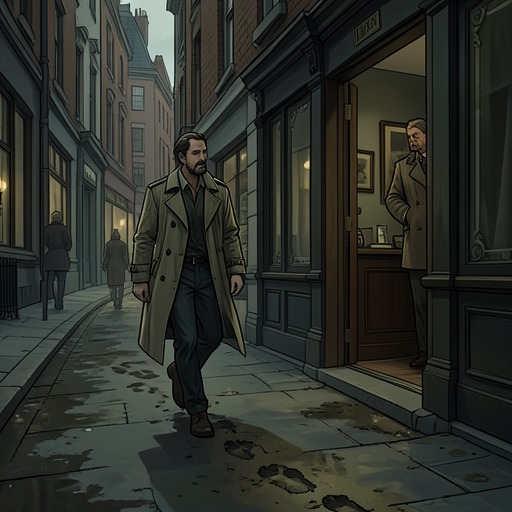
Paris Interpol headquarters on Rue Paul Valéry
The Day of the JackalParis Interpol headquarters on Rue Paul Valéry serves as an early communications hub in the manhunt: from its basement, Claude Lebel and Lucien Caron reach police colleagues across three continents in search of a professional political assassin whose identity and whereabouts remain unknown. The modest entrance and elaborate communications apparatus set the scene for a procedural investigation built on cautious disclosure, shared records, and clues that must be interpreted correctly.
Setting and Communications
At ten minutes to seven, the police car carrying Lebel and Caron stopped outside an unassuming green door on the tiny Rue Paul Valéry. Behind it was the headquarters of the International Criminal Police Organization. The quiet exterior contrasts with the reach of the system inside: the detectives went down to a basement communications room, where they spent the next three hours hunched over a telephone.
The building’s roof carried a dense array of aerials. High-frequency signals travelled out across three continents, bounced off the ionosphere, and returned to distant aerials on tiled rooftops. Wavelengths and scramblers made the communications uninterceptable, allowing detective-to-detective conversations to cross borders without turning the investigation into a public or openly diplomatic exchange.
Lebel’s Appeal
Lebel did not present the request as a formal enquiry between police forces. He told each colleague that the French investigators were still unsure whether an offence had been formed even as an intention, or had progressed into preparation. He characterized the approach as a routine tip-off and acknowledged that they had little to offer: no name and only a poor description.
The request became more pointed when colleagues asked why their help was needed. Lebel explained that the unknown man would have to be among the world’s leading professional contract assassins, with successful political killings behind him—not merely a gangland gunman. He asked whether such a person appeared in their files or came to mind, even if the man had never operated in their countries. The pause that followed exposed the scale of the problem: the search depended on the possibility that other police forces might recognize a specialist whom the French records had not identified.
Role in the Investigation
The headquarters matters less as a place of confrontation than as a node in an information network. Lebel and Caron use its secure international lines to turn a narrowly held French warning into a coordinated search for recognition across national boundaries. The exchange also establishes the investigation’s central constraint: the authorities know the type of threat they face, but not yet the person, name, or location that would make an arrest possible.
The scene gives institutional procedure its own suspense. A seemingly ordinary building, reached through an innocent door, contains the means to communicate across continents; yet even that reach cannot supply the missing identity on demand. The manhunt begins not with a confirmed suspect but with a carefully framed question sent outward through the police network.